

Dhondiba’s Challenge
Restaging Gulamgiri
Snehashish Das
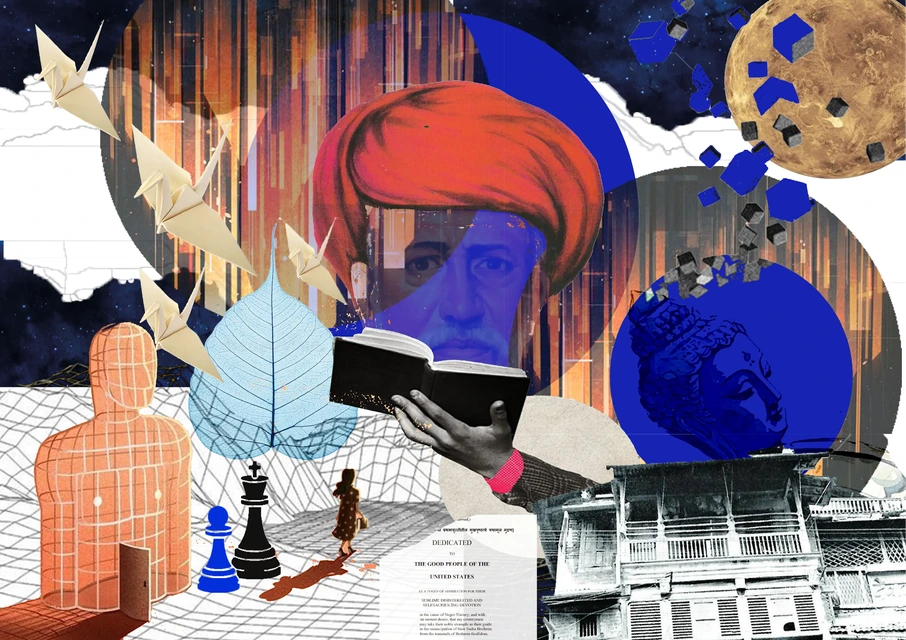
Illustration by Harshada Budhavant
Ever since its publication one hundred and fifty years ago, Gulamgiri (Slavery) by Mahatma Jotiba Phule continues to be reckoned as the masterpiece of the Indian Renaissance movement. Today, we imagine Dhondiba in the same quest for truth as Jotiba, both as emancipated figures. Let's recreate the conversation, but instead of Jotiba taking authority, this time Dhondiba participates equally.
It is a wonderful world in 2073. Our slavery has ended. Jotiba is wearing the same red turban on his head, a white kurta and pants, donning a blue, locally-weaved coat, sipping coffee on the grounds of Bhidewada University. With him is Dhondiba, wearing a black tuxedo. It is Friday on a pleasant winter evening, the grounds of the university are adorned with fallen leaves and flowers of many majestic trees.
Crisp. Fragrant.

Some scholars speculate that Dhondiba is a fictional character, in conversation with Jotiba Phule himself, in his book Slavery. But historian Rosalind O'Hanlon supposes that the character Dhondiba is probably Dhondiram Namadev Kumbhar who was a companion and admirer of Phule, and also was a part of Satyashodhak Samaj (Society of Truth Seekers, founded by Mahatma Jotiba Phule with his companions). See, O’Hanlon, R. (2002). Caste, Conflict and Ideology: Mahatma Jotirao Phule and Low Caste Protest in Nineteenth-Century Western India. (First Published 1985). Cambridge University Press, P. 137. If we go by this supposition, we must also carefully understand the fact that Dhondiram was one of the assassins hired by Brahmins of Maharashtra to execute Jotiba for his endeavor to open doors of schools for women, Sudras and Ati-Shudras (the erstwhile untouchable communities). But Dhondiram, later, being inspired by Phule, became a truth seeker, a polemist and an influential writer with deep knowledge in Hindu religious texts and Hindu rituals. Many of his writings had appeared in Dinabandhu and other newspapers in 1890s. See, Patil, P. S. (2009). Mahatma Jotirao Phule Yanche Charitra. (First Published 1927). Nag- Nalanda Prakashan.
Gail Omvedt writes, “Phule's thought represented the fulfilment of the renaissance desire for social transformation revolutionary lines. He, and not the later elite thinkers, from Ranade through Tilak, should be seen as primary renaissance figure.” See, Omvedt, G. (1971). Jotirao Phule and the Ideology of Social Revolution in India. Economic and Political Weekly, 6(37), 1969–1979.
The text Slavery is in a dialogic form, yet Jotiba takes authority over the conversation as one being the emancipator figure, opposed to Dhondiba who is just one curious being.
Bhidewada is where Jotiba Phule opened his first school to educate Shudra, Ati-Shudras and Women who were/are ritually coerced into ignorance, banned from education in Hinduism/Brahiminism
Jotiba <sips coffee followed by a long sigh>: Baliraja could never die. The upholder of equality, mighty king of our people, the original inhabitants of this land, could never die. Vamana, conniving and treacherous, banished Baliraja to the netherworld. Resting one traitorous foot on his head; thus, the Brahmins spoke. Baliraja may have defeated and died in a war against the Aryan conquerors, but he then emerged from the wombs of many mothers. Of mother Mary and mother Maya. Jesus and our Shakyamuni are only another name, another face, of our liberator, our Baliraja, from another time, at another place in Nirmik’s world.
Dhondiba <placing his cup aside, frowns>: But did Baliraja truly exist in history? Would you believe in the Brahmin's tale? Their many versions where he was pushed into the netherworld, or defeated and murdered?
Jotiba <fixing his turban>: I hold no doubt that Bhats are liars, in addition to being treacherous, and not to forget pompous. What Brahmins claim as a revelation to them, bears no truth. But I wouldn't give them credit so as to think of such an original story. If only their destruction of thought was restricted to themselves. Alas, Brahmins have not just killed the thinking capacities of Shudras, but have killed thought itself.
A story is a product of its time. Baliraja may not be a real subject in real history, but the idea of him is full of truth, full of life. A king of the oppressed cannot be false, but historical. Baliraja, Shakyamuni and Jesus- are all representatives of the idea
of justice.
Dhondiba <staring at Jotiba, frown deepening>: You mean Baliraja, Buddha and Jesus are equally true because they represent justice in the history of the oppressed. But can they be equally true as real historical characters?
Jotiba <pausing before speaking>: To answer your question, unflappably, is difficult for this century. Their stories can be situated somewhere between history and myth. Somewhere they represent our history of strife, our fight for justice, deemed historical, in a temporal and spatial sense. However, in the way we understand time today, they are slightly more mythical than historical. How we understand time in limited numbers, may not find room for their physical/mortal/historical existence in a timeline. In that sense we cannot really find a definite ‘time’ of their origin. Time, as we calibrate it universally (Julian and Gregorian calendars), starts with the birth of Jesus, a specific time in history. But our universal dis-consensus over Jesus' true time and place of birth makes time itself a myth. This makes all the characters of my story equally historical and mythical, or somewhere in between. So, Buddha and Jesus are mythical; just as Baliraja is historical.
Phule, J. G. (1991). Slavery (trans. P.G. Patil). Education Department, Government of Maharashtra, P. 46
Buddha is otherwise called as the Shakyamuni, as he was born as the prince of the Shakyas, after his enlightenment he was known as the Sage of The Shakyas (an ethnicity), the Shakya-Muni.
Phule calls Jesus Christ as Baliraja II (Second Baliraja). He also considers there are many Baliraja in history, such as Shakyamuni (Buddha). See, Phule, J. G. (1991). Slavery (trans. P.G. Patil). Education Department, Government of Maharashtra, PP. 59-61.
Phule uses the term Nirmik to denote ‘the creator’.
A Brahmin surname, but used to denote Brahmin in Jotiba’s texts.
Dr. Ambedkar defined justice as Equality, Liberty and Fraternity, so did Mahatma Phule. In the text Gulamgiri, Jotiba eulogizes Jesus, Buddha and Baliraja for upholding the idea of equality, liberty and fraternity in many instances, and narrates the tale of their works of the emancipation/liberation of the oppressed.
And I assert, a believer is always a knower.
A Brahmin is never a believer -
as he is and was never a mediator between God and humans.
proseterity
Dhondiba <taking a deep breath and standing. Calm, strong>: As a believer of the religion of Abraham, I shall not accept our Lord Jesus can in any way be mythical. Truth is objective for any believer. Unless I believe Jesus was real in history proper, his birth, resurrection and the idea that he will return on Judgement Day, I have not embraced the religion. This is upon you to think, would you assert the real existence of Baliraja, not just as an idea or a reference, but as a person-emancipator in the same confidence as I do for Jesus?
You do not believe Vamana could be real, at least not how the Brahminic scriptures depict him in his gargantuan form. You have always asked rational questions that expose the untruthfulness in the image and story of Vamana. But you take these characters from the same Brahminic spurious scriptures and tell it as if they were real persons from real history, in flesh, living. If Baliraja, a repressed idea in Brahmin tales, were real, the origin of barbaric customs such as Sati would always be (incorrectly) associated with us, the original inhabitants of this country, and not with our conquerors, the Aryans.
What I can understand from your narration of Baliraja is that he was not a single person. He can be many persons across history, emancipators of the downtrodden, virtuous rulers of this land. But Jesus is not many persons, not a reference, but a singular person who existed in history. The distinction between what truly existed in flesh, blood and bone as a person; and what was a persona assigned to an idea, is no frivolous detail. It is important to truth itself. Even if both inspire a common sense of justice and emancipation. As for time, it is standardized with popular consensus, my friend, and certain things are truly knowable.
Jotiba <taking another sip of coffee, also standing up>: If truth is entirely about what's knowable, then to where do we relegate beliefs? Does belief then also constitute truth? You believe that there shall be a Day of Judgement when Jesus shall return, even though it is not knowable, is that placed in the realm of truth? Or is belief itself another paradigm to knowledge or the knowable, as inquiry?
Dhondiba: In a secular political space of this age, faith is often distinguished from knowledge. What one knows is true, but one's belief stands contrary to or at a distance from objective truth. A simple definition of knowledge, across history, is a ‘justified-true-belief’ that constitutes what's knowable. In a sense, what is true in our sense-perception and our beliefs are complementary to constitute knowledge. But of course, none of this is without critique. Yet, I would go with this definition. And I assert, a believer is always a knower. A Brahmin is never a believer- as he knows he is and was never a mediator between God and humans; in fact, he doesn’t at all believe in God, but a deceiver who killed true belief for himself. Every time a Brahmin performs rituals and rites for a Shudra, he knows there is no God who whispers in his ears, takes his words as sacraments, or blesses through his feet. A Brahmin can never be a Satyashodhak (a truth-seeker), but either a liar by design desperate to maintain his hegemony; or a bullshitter who cares for no truth and his bullshitting never gets him in trouble.
My coffee is cold as a Brahmin’s heart now. <chuckling> But hear me out, faith often constitutes the belief in God, while in secular political spaces, non-belief in God constitutes knowledge. It's only an agnostic's question of not just proving the existence of God but simultaneously proving the non-existence of God, which asserts that both theists and atheists operate within the realm of faith and belief, yet also knowledge.
When we speak of the 'infinite universe', we don't have enough evidence to prove that this universe doesn't end somewhere, neither can we prove it is a universe at all, but with available evidence, justifiably, we can believe that, and consider it is true knowledge of our time and space. When you say, "God has granted the freedom to all people, including the depressed and downtrodden, to enjoy equitably all things created on this earth (animate and inanimate)" - it's not just a belief you have, but is also justifiable, thus constitutes true knowledge. When you assert Brahmins as liars and their scriptures as spurious but take characters from their scriptures as true, you stand in contradiction.
Answer me Jotiba, can truth be built upon the foundation of a lie? You may have justifiable reasons for these characters as existing at a point in history, but don't you believe, in the first place, their origins to be untrue? How can I enounce this as knowledge? The foundation of belief I propose as knowledge is not the same as yours.
Jotiba <resting a hand on Dhondiba’s shoulder. Both walk towards the vegetable market>: Your argument stands for reasons. When I think of Shakyamuni's thesis of rebirth — where he says our bodies are made of four living elements; Prithvi, Apa, Tej and Vayu (earth, water, fire and air), and that they live on after the death of the body to enjoin masses of similar elements in Akash (space) — it's apparent that we don't have enough evidence to prove this. However, it's the belief which is justifiable in the paradigm of life he propounded. I must confess that the existence of Shakyamuni and Jesus is true, I believe them to be emancipators of our history.
You have started a churning of thoughts in me. I am rethinking if the idea of the Baliraja that I seek can be as real as Jesus and Shakyamuni. Thank you, my friend. For seconds last centuries, this conversation will too.
Both look at each other, smile, and let out a long sigh.
Hindu scriptures narrate that Vamana, in disguise of a pygmy beggar, had deceived Baliraja by begging three step space to him. When Baliraja promised to grant him his wishes, he took a gargantuan form to take the entire earth in his one foot, kept another foot on the heaven and pushed Baliraja to the netherworld by resting his third foot on Baliraja’s himself.
See, Phule, J. G. (1991). Slavery (trans. P.G. Patil). Education Department, Government of Maharashtra, P. 46.
Phule looks for the origin of the Hindu(-ised) festivals/rituals/customs in reasons that he attaches to the Hindu stories/myths. He says that the queen of Baliraja embraced death by fire, being overpowered by grief in the death of his husband, which he believes is the possible origin of Sati. Ibid, p. 43
Remember that the time is 2073, when the theatre is staged for, the laws and ethos are liberatory. a free political space- aftermath of slavery- where free people are politically charged and engaged, and thinking about what political/religious/social order will be constituted next. Alas, there has been no consensus yet, but as general political spaces of today’s time (2023, India) with secular subjectivity (in the sense of governmentality), yet a continuous struggle happens between science and faith, where faith deems distance from (true) knowledge because of secular governmentality.
See Ichikawa, J. J., & Steup, M. (2018). The Analysis of Knowledge. In E. N. Zalta (Ed.), The Stanford Encyclopedia of Philosophy (Summer 2018). Metaphysics Research Lab, Stanford University. https://plato.stanford.edu/archives/sum2018/entries/knowledge-analysis/
For example, to think if a chair exists here, it is not enough to understand/feel the chair through our sense or use logic of forms as perception. But one also needs to believe that chair is not somewhere else as well, or this world/reality is true, not just a dream or a simulation- so that chair truly exists here.
Manusmriti says, “To Brahmanas he assigned teaching and studying the Veda” (v.1.88.), and “Of Brahmanas, those learned (in the Veda); of the learned, those who recognise (the necessity and the manner of performing the prescribed duties); of those who possess this knowledge, those who perform them; of the performers, those who know the Brahman/Lord Brahma” (v.1.97.)- which only means that only Brahmins can mediate between God and humans. Manusmriti also says that possession of Veda makes a Brahmin the lord of the whole creation (v.1.93.)- this statement also defines that the supreme ability of mediation between God and humans by possessing knowledge is the origin of Brahmin supremacy and inequality. According to the above, all Brahmins are priestly.
Here, we may also take the example of Zguangzi’s butterfly-dream parable that asks us if we are humans dreaming as butterflies or a butterfly dreaming as humans- takes our entire existence to the epistemological skepticism, unsolved, yet we read this parable in the history of knowledge. See, Zhuangzi And That Bloody Butterfly | Issue 76 | Philosophy Now. (n.d.). Retrieved November 4, 2022, from https://philosophynow.org/issues/76/Zhuangzi_And_That_Bloody_Butterfly
Phule, J. G. (1991). Slavery (trans. P.G. Patil). Education Department, Government of Maharashtra, P. 25.
Ambedkar, B. R. (2014c). The Buddha and His Dhamma. In Dr. Babasaheb Ambedkar: writings and speeches, vol. 11. New Delhi: Dr. Ambedkar Foundation, P. 330.
Snehashish Das (mx.snehashish@gmail.com) is a PhD Scholar at the Centre for the Study of Social Systems, Jawaharlal Nehru University, New Delhi. They are an Ambedkarite person and active in Bahujan student politics. They live in sci-fy and on-the-edge thoughts, and write poetry or paint when angry or in love.